
You are sitting in your living room. You look at a beam of sunlight. You see thousands of tiny dust motes dancing in the air. It makes you wonder: is the air you breathe actually clean?
When you start shopping for an air purifier, you see a lot of technical terms. One acronym pops up more than any other. You see it on every box and every website. But what does CADR stand for, and why should you care?
This single metric is the secret to buying the right machine. It is the difference between breathing crisp, clean air and wasting your money on a fancy fan. Let’s dive into everything you need to know.
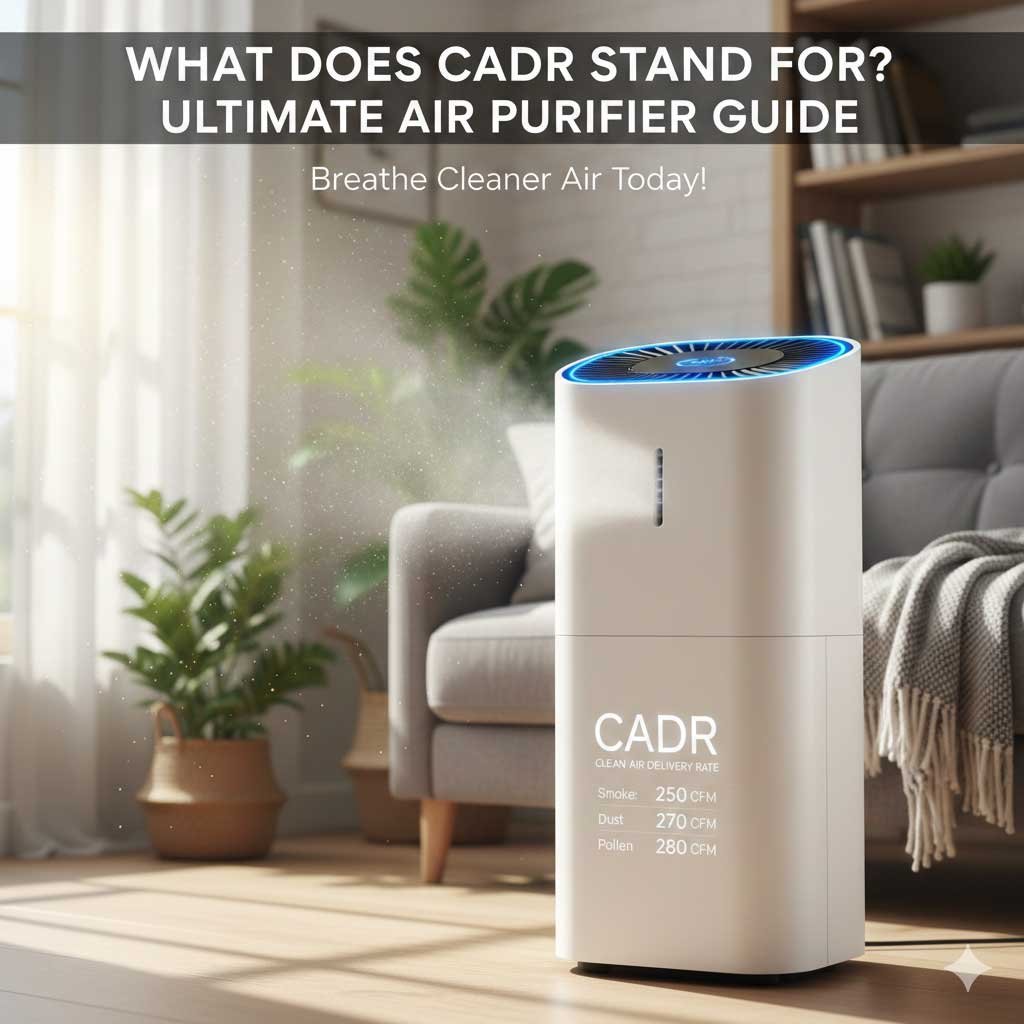
Table of Contents
The Simple Definition of CADR
CADR stands for Clean Air Delivery Rate.
This metric was developed by the Association of Home Appliance Manufacturers (AHAM). It is not just a marketing term. It is a scientific measurement. It tells you exactly how much filtered air an air purifier produces at its highest speed setting.
Think of it like the horsepower in a car engine. A high CADR means the machine moves a lot of air quickly. A low CADR means the machine works slowly. If you have a large room, you need a high CADR to keep up.
Why CADR Matters for Your Home
You might think that a filter’s efficiency is all that matters. You see “HEPA” on the box and assume you are safe. However, efficiency and delivery are two different things.
A filter might be 99.97% effective at catching dust. But if the motor is weak, it will only clean a tiny bit of air every hour. You need a machine that combines a strong filter with a powerful fan.
CADR measures the result of that combination. It gives you a clear number to compare different brands. Without it, you are just guessing.
How is CADR Calculated?
Scientists test these machines in a controlled environment. They use a room that is about 1,008 cubic feet. They fill the room with specific pollutants. Then, they turn the air purifier on high.
They measure how fast the particles disappear. They compare this to how fast particles settle naturally. The difference between the two is the CADR. The rating is usually expressed in cubic feet per minute (CFM).
Three Pollutants
CADR is not just one number. Usually, you will see three separate ratings:
- Tobacco Smoke: This measures the smallest particles (0.09 to 1.0 microns).
- Dust: This measures medium-sized particles (0.5 to 12 microns).
- Pollen: This measures the largest particles (5 to 11 microns).
| Pollutant Category | Particle Size Range | Why It Matters |
| Smoke | Smallest (0.09 – 1 µm) | Most dangerous for lungs; hard to catch. |
| Dust | Medium (0.5 – 12 µm) | Common allergen found in every home. |
| Pollen | Largest (5 – 11 µm) | Triggers seasonal allergies and asthma. |
The “Two-Thirds Rule” for Your Room
How do you use these numbers? You don’t need to be a math genius. There is a simple trick called the Two-Thirds Rule. To get the best results, you want a smoke CADR that is at least two-thirds of your room’s square footage.
- Example: You have a room that is 150 square feet.
- The Math: $150 \times (2/3) = 100$.
- The Goal: You should look for an air purifier with a smoke CADR of at least 100.
If your ceilings are higher than 8 feet, you should aim even higher to maintain the Air Changes Per Hour (ACH).
Limitations of CADR: What It Doesn’t Tell You
CADR is a great tool, but it isn’t perfect. You should know what it ignores.
- It Doesn’t Measure Odors: CADR only looks at particles. It does not measure how well a machine removes smells or VOCs (chemicals). For those, you need a heavy Activated Carbon filter.
- Highest Speed Only: The test is done on “Turbo.” If you run your machine on “Sleep” mode, your actual CADR will be much lower than what is on the box.
- Filter Life: A machine might have a great CADR when the filter is brand new. If the filter gets clogged quickly, that performance will drop over time.
How to Choose CADR Based on Your Needs
Not everyone needs the highest CADR possible. Your lifestyle dictates your requirements.
For Allergy Sufferers
If you sneeze every morning, you need a high Pollen and Dust CADR. Look for a machine that is rated for a larger room than the one you actually have. This ensures the air stays extremely clean.
For Pet Owners
Pets produce dander and hair. These are medium-to-large particles. You want a strong Dust CADR. You also want a machine with a Pre-filter that you can vacuum to keep the airflow high.
For City Dwellers
If you live near a busy road or in a wildfire zone, Smoke CADR is your priority. Small soot particles are dangerous to your health. Do not compromise on this number.
Tips to Maintain High Performance
To keep your air purifier running like new, you need to be proactive. A high-quality machine is an investment in your health. If you neglect it, the performance will drop, and your indoor air quality will suffer. Here is how you can maintain a high Clean Air Delivery Rate year-round.
1. Change Filters on Schedule
Most modern units have a filter replacement light. Do not ignore it! Over time, the HEPA material becomes packed with microscopic debris. This makes it harder for the fan to pull air through. When airflow is restricted, your CADR drops significantly. Always keep a spare filter in your closet so you can swap it out immediately.
In some cases, proper maintenance can restore airflow and extend filter life, especially when done correctly and safely.
2. Clean the Pre-filter Every Two Weeks
The pre-filter is your first line of defense. It catches large items like pet hair, lint, and big dust bunnies. If this outer layer is clogged, the inner filters can’t do their job. Most pre-filters are washable or can be cleaned with a vacuum hose. Keeping this layer clear is the easiest way to maintain peak airflow.
3. Give the Sensors a Wipe
Many smart air purifiers have “Auto Mode” sensors. These laser sensors detect particles in the air. If the sensor lens gets covered in dust, the machine might think the air is clean when it isn’t. Use a dry cotton swab to gently clean the sensor opening every few months to ensure accurate readings.
4. Optimize Placement for Airflow
Your air purifier needs room to “breathe.” If you tuck it behind a curtain or press it against a wall, you create a “dead zone.” This prevents the machine from circulating air from the far corners of the room. Place the unit at least two feet away from furniture and walls to maximize its effectiveness.
5. Run the Machine Consistently
Air quality is not static. Every time you open a door or cook a meal, new pollutants enter the room. Instead of running the machine on high for one hour, try running it on a medium or low setting 24/7. This keeps the air constantly moving through the filter and prevents allergens from settling on your carpets and furniture.
FAQ
Generally, yes. A higher CADR means faster cleaning. However, higher CADR often comes with a larger machine and more noise. You should balance performance with your room size.
Absolutely. In fact, this is a great idea. It will clean the air much faster and allow you to run the machine on a quieter setting while still getting excellent results.
Indirectly. Viruses often travel on larger particles like droplets. By removing these particles, the air purifier reduces the overall “viral load” in the room.
For an average bedroom (approx. 200 sq. ft.), a CADR of 150 or higher for each category is considered very good.
Testing is voluntary and expensive. Some brands choose not to use AHAM testing. However, without a CADR, it is very hard to verify their performance claims.
No. CADR only measures air volume. You should look for the Energy Star label to see how much electricity the machine uses.
Yes. If you live in a wildfire-prone area, focus exclusively on the Smoke CADR. You want the highest number possible to deal with fine particulate matter.
Bottom Line
Finding the right air purifier does not have to be a guessing game. Now that you know what does CADR stand for, you have the power to shop with confidence. Remember to use the Two-Thirds Rule and match the rating to your specific room size. By focusing on Clean Air Delivery Rate, you ensure that every breath you take is as fresh and healthy as possible.


Leave a Reply